Everyone saw the headline. NBA expanding to Seattle and Las Vegas.
SuperSonics Twitter woke from a 17-year coma. Las Vegas people immediately started arguing about arena names. Someone definitely opened a futures market tab.
Here’s what actually happened.
The NBA hit “Explore.” Not “Confirm Order.”
On March 25, 2026, the NBA Board of Governors voted to formally explore potential expansion to Seattle and Las Vegas. They hired a banking firm called PJT Partners to look at markets, arena situations, and ownership groups.
That’s the whole announcement. We’re going to look into it.
Here’s what is not confirmed:
- Team names. The SuperSonics are not back. That’s not official. Calm down.
- Ownership groups. “Interested parties” is not the same as “selected owners.”
- A start date. Earliest discussed: 2028–29. Not locked.
- That it even happens at all.
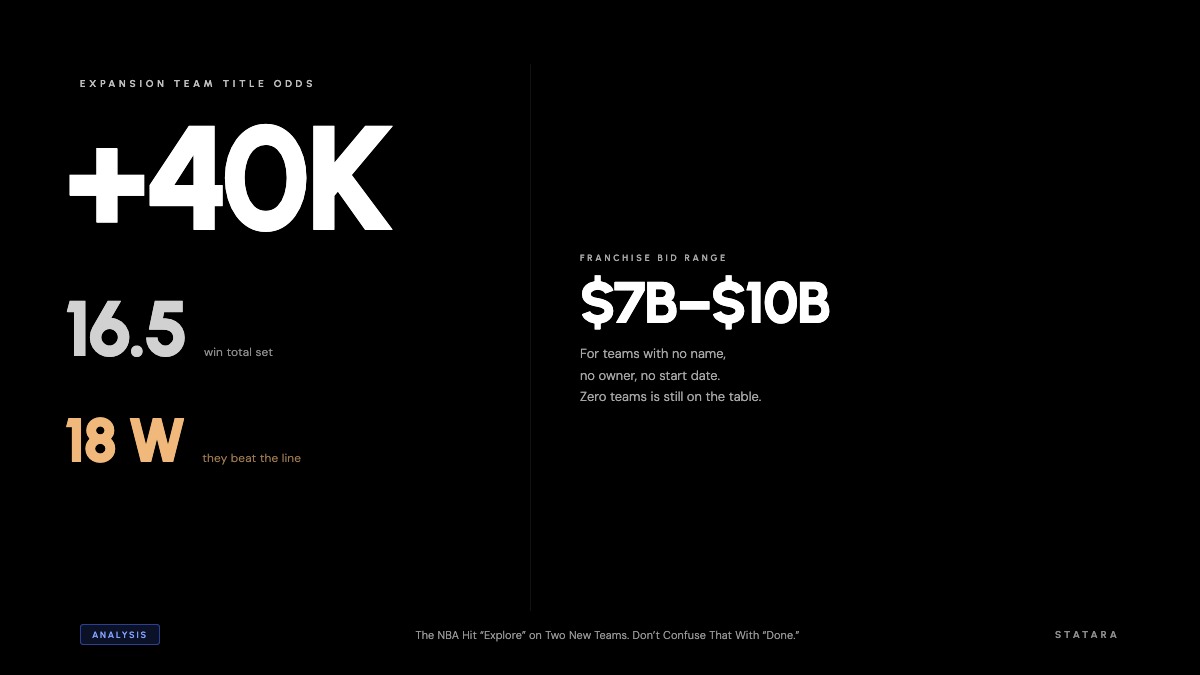
That last one. Adam Silver publicly said the final answer could be zero teams. One team. Or two. Zero is on the table. The commissioner of the NBA said that with his mouth.
Seattle’s situation
The signals are real. The Kraken ownership group — led by Samantha Holloway — quietly created a new corporate entity called One Roof Sports & Entertainment and grabbed a majority stake in Climate Pledge Arena.
That is not subtle. That is “we are building the vehicle for an NBA bid.”
But building the vehicle is not the same as driving it. It’s the basketball equivalent of buying a ring box before you’ve proposed.
Las Vegas’s situation
Bill Foley is interested. A group connected to Magic Johnson is interested. Multiple billionaires are hovering. Great.
The problem: T-Mobile Arena — the obvious venue — may not actually work long-term. Adam Silver himself said he’s not sure it’s an adequate fit. So Vegas might need a new building. While Seattle already renovated one.
Multiple ownership groups. Arena questions. No selected owner. No name. 2028–29 at the earliest. And zero teams is still on the table. Let that sink in.
Oh, and the NBA also wants a whole European league
While North America was processing two cities, the NBA and FIBA quietly announced they’re pursuing a 16-team European league. Twelve permanent spots, four rotating in on merit. Think promotion/relegation energy without the actual relegation.
Already have 120+ proposals. Some bids reportedly hitting $1 billion. Target launch: October 2027.
Cities in the conversation: London, Paris, Madrid, Barcelona, Berlin, Rome, Milan, Istanbul, Athens, Munich.
Two separate expansion tracks running at the same time. One league. This is a lot of tabs open simultaneously.
Conference realignment is already in the math
If two teams join, someone’s moving conferences. Names being floated: Minnesota Timberwolves, Memphis Grizzlies, New Orleans Pelicans — geographic logic, basically. This matters for futures, playoff seeding, division odds. Any market built around conference structure gets repriced.
What this actually does to betting
If the league goes from 30 to 32 teams on an 82-game schedule, that’s roughly 82 more NBA games per year to bet on. More markets, more props, more futures. Great in theory.
In practice: chaos, at least early.
Expansion teams open at comically large plus-money
The Charlotte Bobcats in their 2004–05 debut: +40000 to win the title. The Toronto Raptors and Vancouver Grizzlies in 1995–96: +75000 each.
The Bobcats’ win total was set at 16.5. They won 18. The over hit. But nobody felt confident backing it, because the Bobcats were, in fact, bad.
That’s the expansion team dynamic in one sentence: obviously terrible, but sometimes still better than the line.
Win totals for new teams will be set conservatively and argued about loudly, because there are no priors and everyone has opinions. Books will open low, move fast when sharp money arrives, and shade toward local fanbase sentiment.
Sportsbooks are going to be very cautious early. That’s not an accident.
New team = no history = no model = tight limits on everything.
- Expansion futures: available, but small limits
- Win totals: conservative opens, fast line movement
- Props: high hold, low limits, frequent “no thanks” on novelty markets
- First season: you are functionally betting on narrative
Books don’t make money on chaos. They make money on models. And you cannot model a franchise that doesn’t have a roster, a coach, or a name yet.
Seattle has a betting law situation you probably don’t know about
If you’re imagining a Seattle franchise means Washington state opens up statewide mobile betting so everyone can wager from their couch — that’s not how it works.
Washington’s sports betting is tied to tribal casino compacts. It’s not broad statewide mobile by default. A new NBA team doesn’t automatically change the regulatory structure. That requires actual legislative action, which may or may not come.
Las Vegas, on the other hand, already has the infrastructure. The friction there is pure arena and ownership selection, not betting legality. Vegas is structurally built for high-throughput NBA wagering the moment a team exists.
The bottom line
The NBA opened a tab. The process is real, the signals are serious, and Seattle especially looks like it’s been quietly doing the homework. But nothing is awarded, nothing is named, and a decision in 2026 could still land on zero new teams.
When expansion teams eventually arrive, history says: expect extreme longshot title odds, low win totals with real variance, and a market that moves fast in year one because everyone’s operating on vibes and narrative.
The Bobcats were +40000 to win the title. They won 18 games. They beat the line.
That’s expansion betting in a nutshell. New information arrives unevenly, the narrative is always loud, and everyone in the room thinks they’re the genius.
Most of them won’t be. But it’s going to be a great few years of trying.
Expansion changes the whole board — win totals, conference futures, player props. Statara tracks the patterns so you can see what’s actually moving before the market does.