You know that feeling after a bad loss where you absolutely should not place another bet, and you do it anyway? That’s not weakness. That’s architecture. And it was built specifically for you.
Nobody wants to hear this first bit. But you need to.
The bookmaker has the edge before a single ball is kicked
It’s in every price. Every market. Every accumulator you’ve ever been quietly convinced about.
In 2023, Americans bet $120 billion on sport. Sportsbooks kept $10.9 billion of it. That 9% isn’t bad luck. It’s the design.
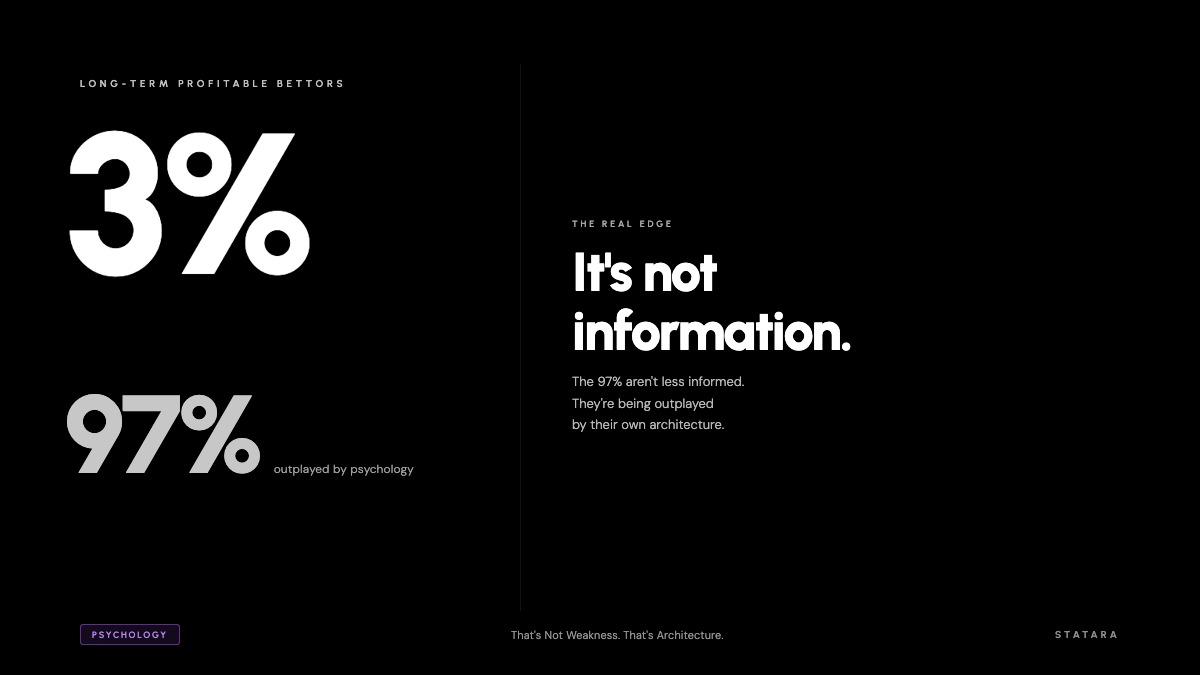
Only 3% of sports bettors make money long-term. Three. Percent.
And here’s the thing — those people aren’t better at sport than you. They’re better at making decisions than you. That’s actually good news. Because decisions can be fixed.
Your brain was not built for this
Human beings are genuinely terrible at probability. We’re wired for story, pattern, and cause and effect. It’s why we’re great at “that rustling in the bushes is probably a predator” and catastrophically bad at “this roulette wheel has no memory.”
When a horse wins three races in a row, we feel certain the fourth is coming. When you’ve lost four bets in a row, you feel like you’re due a winner. Neither feeling has any mathematical basis whatsoever.
The first error has a name: the hot hand fallacy. The second is the gambler’s fallacy. Both lead to the same place — bets placed on feeling rather than probability.
Bookmakers don’t just know about these biases. They price their markets around them. The house isn’t just beating you. It’s been specifically designed to use your own brain against you.
80% of bettors believe they can make money long-term. 3% actually do. That gap — between what bettors believe about themselves and what’s actually happening — is one of the most expensive gaps in human history.
Your memory is also lying to you
A peer-reviewed study compared what bettors said their results were to what their account records actually showed. Between 34% and 40% were consistently distorting their own outcomes. Underestimating losses. Overestimating wins. Not lying to the researchers. Lying to themselves. Without even knowing it.
You can’t fix a problem you don’t think you have.
So start there. Write everything down. Every bet, every stake, every reason you told yourself it was a good idea. Not to celebrate the wins. To see yourself clearly.
You don’t just distort your results in the moment. You distort them over time. The same peer-reviewed study found that sports bettors had the worst recall accuracy of any type of gambler. Not lottery players. Not casino players. Sports bettors — the people who feel most informed, most analytical, most in control — were the least accurate at reporting what had actually happened to their money.
A separate study found that only 7% of bettors could accurately recall their results over a 12-month period. Seven percent.
Which means 93% of bettors are making decisions based on a record that doesn’t exist. Feeling confident based on wins they’ve inflated and losses they’ve quietly filed away. Building a strategy on a foundation that is almost entirely fictional.
You’re chasing. You know it. You do it anyway.
Losing $50 feels about twice as bad as winning $50 feels good. That’s not a vibe. That’s Nobel Prize-winning psychology. Kahneman and Tversky proved it in the 1970s.
When you lose, the pain is disproportionate. And the fastest way to kill that pain is to place another bet and get back to even. That’s chasing.
Over half of all sports bettors have done it. Research classifies it as the defining marker of the transition from recreational betting to a real problem. A study of 12,000 online bettors found that chasing in the first month predicted mounting losses in every single subsequent month. Every. Single. One.
That urgent feeling after a loss — the one that says you need to act right now — is not strategy. It’s pain looking for a shortcut.
You’re not researching. You’re looking for reasons you were right.
You decide to back a team. Your brain immediately becomes their biggest fan.
You find the preview that says they’re in great form. You skip the one about the injury crisis. You find the pundit who agrees with you and promote him to genius. The one who doesn’t? Probably doesn’t even watch the sport.
This is confirmation bias. The “research” most bettors do after making a decision isn’t research at all. It’s a highlights reel of reasons they were right.
The fix is almost embarrassingly simple: before you make the case for a bet, make the case against it. Actively look for the reason not to place it. If it survives that, it’s a better bet. If it collapses under one contrary opinion, you just saved yourself money.
Winning streaks are quietly destroying you
After a run of winners, something shifts. Stakes drift up. Bets you’d normally skip start looking fine. The winnings start to feel somehow not like real money — like chips in a casino rather than cash in your pocket.
Economists Thaler and Johnson called this the house money effect. A study of 42,000 gamblers across 17 million plays confirmed it — bettors raised their stakes significantly after win streaks, with the biggest jumps coming after three consecutive wins.
The bookmaker doesn’t need you to lose every bet. They just need the stakes on your losing bets to be bigger than the stakes on your winning ones. A winning streak does exactly that job for them. Without you noticing. While you’re feeling great about yourself.
The app is not your friend
The platform you bet on was not built to help you win. It was built to keep you engaged. These are related but very different things.
Notifications when your team is playing. One-tap deposits. In-play markets refreshing every thirty seconds. Cash-out offers landing at the exact moment you’re most anxious. The next event always right there.
85% of all US bets are now placed on mobile. A 2025 survey found 1 in 4 sports bettors had missed a bill payment because of gambling. 30% blamed betting directly for personal debt.
Every single feature in that app was designed to keep you in an emotional, reactive state. That is not a side effect. That is the product.
So here’s the actual edge
To break even, you need to win 52.4% of your bets. To actually make money over time: somewhere between 55% and 57%. That’s it. That’s the whole gap between the 3% and everyone else.
You close that gap not by knowing more about sport. By making better decisions more consistently with less emotional noise getting in the way.
Honest records. Catching the chase before you act on it. Arguing against your own bets before you place them. Fixed stakes. Knowing the app is playing you.
None of it is glamorous. All of it works.
You already know the sport. The part most people skip is knowing themselves. That’s where the money actually lives.
- American Gaming Association — $119.84B wagered 2023, $10.9B revenue
- Long-term profitability 3% — boydsbets.com, betteredge.com
- 80% believe they can profit — Siena College / St. Bonaventure (2024)
- 34–40% distort results — Braverman et al. (2014), Psychology of Addictive Behaviors
- Loss aversion — Kahneman & Tversky (1979), Econometrica 47(2)
- Over half have chased — Siena College (2024)
- Chasing predicts losses — International Gambling Studies (2023)
- Only 7% recall 12-month results accurately — Braverman et al. (2014)
- House money effect — Thaler & Johnson (1990), Management Science 36(6)
- Stake increases after win streaks, 42,000 gamblers — Journal of Economic Behavior & Organization
- 85% bet on mobile — AGA (2025)
- 1 in 4 missed bill payment — US News & World Report (2025)
- Confirmation bias — Gilovich (1983), Journal of Gambling Studies
- Gambler’s fallacy — Tversky & Kahneman (1971), Psychological Bulletin 76
- Hot hand — Gilovich, Vallone & Tversky (1985), Cognitive Psychology 17(3)
Statara tracks your patterns, your behaviour, your decisions — so you can finally see what’s actually happening.